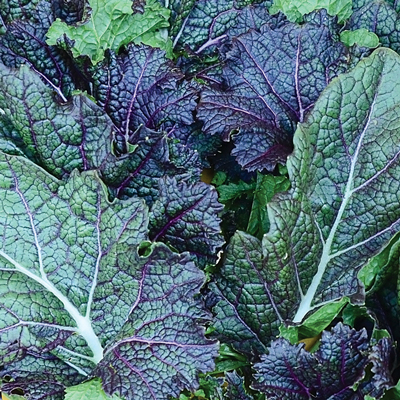
Giant Red Mustard is a staple green in our kitchen. This is my husbands favorite leafy green by far!
Perfect for companion planting with slow growing vegetables or flowers, mustard is a true “cut and come again”. Harvest individual leaves for sandwiches, salads or a stir fry. The large leaves can be used as wraps for a low carb and gluten free bread replacement.
Mustard is excellent combined with sweeter greens in “wilted” salads and perfect for some flavor in smoothies.
This variety is very cold hardy and withstands frosts with ease. Mustard is perfect for shade gardens and those that are a bit cooler.
Fall in love with flavor with an old fashioned green.
“Agriculture and seeds provide the basis upon which our lives depend. We must protect this foundation as a safe and genetically stable source for future generations. For the benefit of all farmers, gardeners, and consumers who want an alternative, we pledge that we do not knowingly buy or sell genetically engineered seeds or plants. The mechanical transfer of genetic material outside of natural methods and between genera, families or kingdoms, poses great biological risks as well as economic, political, and cultural threats…”
All of the links to sign the pledge, research the pledge or contact the Council for Responsible Genetics are no longer viable.
The USDA has a tool that outlines annual extremes for minimum temperature across 13 areas of the U.S.
An example of a zone represented in Southcentral Alaska is zone 4.
The USDA map has minimum temperatures of -30F to -20F for zone 4.
We can use this zone tool to help guide us when adding perennials (plants that live more than two years) and biennials (plants that complete their lifecycle in two years) to our garden spaces.
If I am shopping and find a “zone 7” plant , I may be able to grow this plant as an annual but the rate of overwinter survival will be less as the minimum temperature for a “zone 7” plant is 0F to 10F and the minimum temperatures in zone 4 may be way too cold for this plants survival without certain extreme protection measures.
When we are discussing annual plants (those plants that complete their life cycle in one year) we need know our frost free dates. This is the span of time where we can reasonably expect not to have killing frosts (28F and below).
For my landscape and microclimate growing spaces this is from May 1 (ish) – Sept 30 (ish). As nature doesn’t always fit in the “box” we can expect seasons to extend and sometimes shorten.
Nature is dynamic…not static
Certain plants can withstand much colder temperatures and overwintering with meticulous care of the soil, the enhancement of natural microclimates and a keen understanding of individual plant species coupled with extensive season extension. Taking growing risks is a fun garden challenge I look forward to every year.
We can use these tools as a guide to direct us towards plant choices and landscape design. Check your zone for perennials and biennials and know your frost free dates for annuals.
During the growing season life is abundant across our landscape. Birds, bees, moose, ermines, foxes, voles and insects of all kinds can be found shacking up or passing through for hydration and nutrition.
Once we stopped removing all the plant material at the end of the growing season, it allowed the living roots from the harvested crop to finished their legacy and exchanges within the soil economy. This process vastly improved our soil but it also provided the necessities for life to return to the land…even in winter.
There is as much life on our landscape during the days governed by King Winter as there is in the days engrossed in the midnight sun. With the exception of the warm weather insects we still have life here- in the bitter cold.
Plant a row for wildlife this coming season. Design a space where flowers are allowed to go to seed so that our friends of the air can sustain. Allow the spent plant material of the harvest to give shelter to those that need a little more protection. The amount of joy that this has brought to my heart during the winter months is immeasurable. I hope that these small actions will bring you some happiness as well.